
The Case for Training 3x a Week After 40
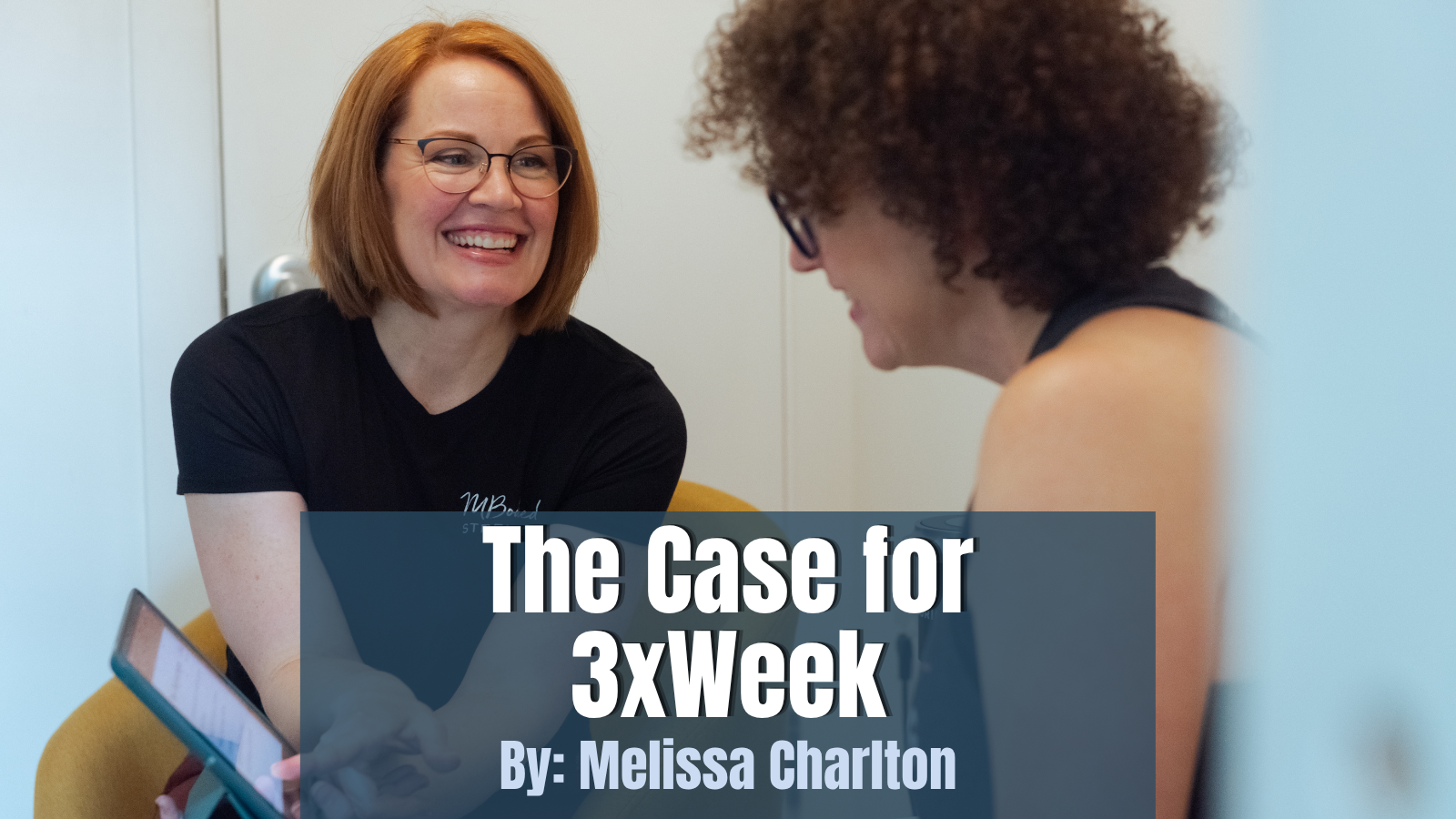
By: Melissa Charlton
Meet Your Future Self
Picture yourself at 75. What comes to mind? Grey hair, sitting on the couch watching too-loud tv, carefully shuffling to get around? We’ve all met 75 year olds like that. But there’s a different type of 75 year old, too.
So let’s try that again. Imagine that you’re 75. Maybe you’re walking the endless cobblestone streets of Rome, drinking in history as you search for that one restaurant your hotel told you about. Or maybe you’re snapping photos of floppy-eared cows in Germany, on your way to wander in the Alps. Or maybe you’re meeting harbor seals and humpback whales from the seat of your kayak while you explore the waters around San Juan Island. (These are my dreams, I confess)
Here’s another question: Is your current strength training plan going to get you there in 35 years?
For the past 20 years, I’ve mainly only offered 2xWeek training, because I’m aware that cost and time commitments can be a deterrent in this business. But I have to be honest. It’s not enough. Not for the future we dream of.
What 2xWeek Can Do (and what it can’t)
Ok, so 2xWeek isn’t nothing, and I have to give credit where it’s due: you can get stronger on 2 days of strength training per week. But there are limits, and over time the results are slower and less effective.
The research backs this observation up, showing that 3xWeek strength training outperforms 2xWeek, across all populations, for strength training alone.¹ ²
You cannot hit every muscle group with adequate volume and frequency, if you only train 2xWeek. Therefore, your trainers are often forced to choose fewer movement patterns, because we have to focus on balancing the body and getting the most important moves.
For strength training alone, we want to program mobility, activation, core, balance, a push, a pull, a lower push, a lower pull, lateral movements, rotational movements, carries, and then all the accessory muscles.
Programming for 2x/Week, we have to compromise here and there; choosing hamstrings over quadriceps, or we skip biceps and triceps, or we have to cut out that stability move that gives you more muscle endurance.
We may be able to get these moves in the next cycle, but by doing so we gradually slow down the process of gaining muscle. And because there’s a short window to gain muscle if you’re starting in your mid-30’s or later, time is of the essence.³
The other things we have to compromise? Reactive training (power and the ability to absorb force); as well as agility (the ability to quickly change direction); and grip (yes we work on grip strength, but not often enough).
You do see these things cycle through, but they’re not as frequent as you need for building true joint resilience, as well as improving the reaction time and power to stop yourself from landing on your face when you trip and fall.
So what’s the big deal with reactive, grip and agility work?
Power is the first physical quality we begin to lose with age; this is because fast-twitch muscle fibers begin atrophying in our late 30s (those are the ones that help us catch ourselves when we trip).
Strength training alone can’t fully slow this decline, because fast-twitch muscle fibers disappear without targeted training. Without specific power training, your base strength stays and explosiveness goes.⁴
Grip strength is a big predictor of your future. An 8-year study of 5,472 women aged 63-100 showed that the women in the highest grip-strength group had a 33% lower risk of death vs the lowest group.
But even if you don’t want to live to 100, let’s look again at that picture of your future self. Hiking poles, kayak paddles, knitting needles, and just holding onto the railing as you descend the stairs at the theater? These are all grip-dependent, which tells us that grip strength is not a gym metric. It’s a life metric.
Bone density and the perimenopause window
More than 25% of women in the menopausal transition experience accelerated bone mineral density loss. This is due in large part to missing the training window. Bone loss begins around age 40 (for women and men, but men have fewer hormonal and societal impediments to maintaining bone mineral density).
This decade of training matters enormously for what comes next. And the way to train for that is with IMPACT.
Jumping, running, stepping off a high step and landing on your feet? This kind of work stimulates bone mineral growth, and by not having enough of it in our program, we’re doing you a disservice.
What 3x/Week Actually Looks Like
You’re already getting a full-body workout during your sessions, and that won’t change. By working full-body every session, you’re guaranteed to get your heart-rate up and hit multiple muscle groups without completely burning out your upper or lower body.
Now, however, we get to add in enough plyometrics, agility, grip, balance AND mobility to every workout, and for every cycle. Where before we could only get grip strength, but had to compromise power or mobility, now we can make sure they repeat often enough to actually improve the skills, while also creating enough stimulus for real muscle growth.
What’s really going to change from session to session is emphasis. Some days we may lean into heavier lower body loading, to build power. Others will feature more plyometric and speed work. And some days will have a little more mobility, stability and grip work.
All this, without compromising a full-body strength training program that keeps your body balanced and gaining muscle from cycle to cycle.
2x/Week’ers, We Still Got You.
We know not everyone can train 3xWeek, so if you’re only coming 2xWeek, we’ll still make sure you get a balanced program.
You’ll also be invited to try the 3rd day program some weeks, so you see what that workout feels like in your body. This could help some highly motivated people to do their 3rd day at home.
Train for the Life You Want
At the end of the day, the training program you can reliably attend is going to be the most effective one for you.
And we’ll make sure what you get is the right mix for your specific goals.
Whether your goals are gardening, walking to meet friends at a local cafe, paddling around Puget Sound, or even snowshoeing or mountain biking, our new program will meet you where you are, and help you get where you plan to be.
We love talking about this stuff, so if you have any questions about how this will affect your program, please reach out to your trainer
References
¹ Higher frequency & muscular strength — NIH/PMC https://www.ncbi.nlm.nih.gov/pmc/articles/PMC6036131/
² 3x vs 2x/week in older women (24-week RCT) — IJES via WKU Digital Commons https://digitalcommons.wku.edu/ijes/vol12/iss6/8
³ Menopause Transition: A Cross-sectional Evaluation of Muscle Size and Quality - https://pubmed.ncbi.nlm.nih.gov/36878186
⁴ The importance of reactive/power training – National Academy of Sports Medicine https://blog.nasm.org/training-benefits/the-importance-of-reactivepower-training
⁵ Perimenopause & bone loss — PeKnO Study — NIH/PMC https://www.ncbi.nlm.nih.gov/pmc/articles/PMC8871419/
Additional Supporting Articles
Training frequency & strength gains — Stronger by Science https://www.strongerbyscience.com/training-frequency/
Grip strength & longevity in women (JAMA) — Study Finds / JAMA Network Open https://studyfinds.com/strong-grip-longer-life-muscular-strength-predictor-longevity-aging-women/
Grip strength & mortality risk — Confluent Health https://confluenthealth.com/resources/grip-strength-a-measure-that-holds-onto-longevity/
HiRIT for perimenopause bone preservation — STOP-EM Trial — NIH/PMC https://pmc.ncbi.nlm.nih.gov/articles/PMC11800298/
Muscle strength & longevity in women — Medical News Today / OPACH Study https://www.medicalnewstoday.com/articles/stronger-muscles-longer-lives-study-benefit-older-females-aging
Melissa Charlton
Founder, NASM CPT, GGS Menopause Specialist
I am inspired by my mother, who gave it her all to give us a better life. Leaving a bad marriage but still needing to raise four children, my mom did everything she could to make ends meet. This meant learning new skills and working 16-hour days, constantly wearing herself down and pouring from an empty cup. She’s my hero, but she’s also my cautionary tale.
Now I'm a mother and a business owner, and I owe it to my son and my community to prioritize myself while I build a business that supports women just like her. I consider it my honor to teach you how to take better care of YOU. So you can be the leader your people need. Proper self-care makes it possible for you to give the best of you, rather than just the rest of you.