
You don’t. I’ll Explain.
By: Melissa Charlton
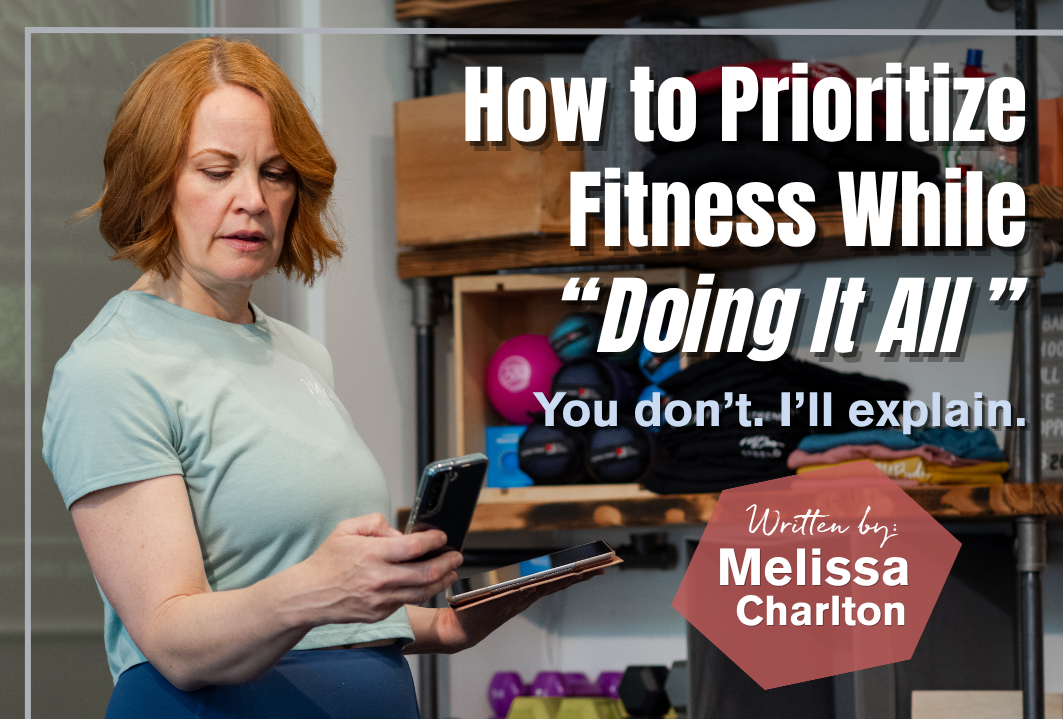
I’ve always suffered from overload. Some of that is from societal pressure. Some of it is having a job that requires a lot. And some of it is just my delusions of grandeur.
Shortly after opening the studio, I remember having an argument with my therapist. I was upset because I had lost some muscle and gained weight, and wasn’t spending enough time with my family or friends.
I asked my therapist, “Why are some people able to do it all? And what’s wrong with me, that I can’t?” (I was serious)
She laughed, giving me a “little buddy” face, before she said, “Oh Melissa. No one is doing it all.”
I got mad and doubled down. “No. I should be able to run a business, spend time with my family, maintain my friendships AND maintain my fitness. It’s not that much! Other people do it. I see it all the time!” (Yes, I was aware of the “highlight reel” effect, and I still thought it didn’t apply to me in that moment)
We went back and forth for the whole session, and I wouldn’t give in because I honestly believed other people were more effective and there must be something wrong with me.
Mind you, I had just opened my doors! I was coming off of all the creative work of the business plan and model, negotiating the lease and designing the space, budgeting and securing funding, researching and purchasing equipment, and was in the midst of interviewing trainers while still training clients.
The question wasn’t if I was going to see a dip in my workout performance. The question was, why was I so surprised?
Eventually, I came around to agreeing with my therapist. And I’d like to say that I moved on and never struggled with that belief again. But that would be a lie.
I still do it. Every time I take on a big challenge in the business, I get really down on myself when my fitness flounders. Whether it’s losing and hiring a new trainer, revamping our client experience, or (as I’m currently doing) growing into a larger location and repeating all the steps I took before but with even more pieces to navigate. I still hold myself to impossibly high standards and then spiral into feelings of inadequacy when I can’t meet them.
Now, however, I have guardrails to get back on track. Here’s what helps me:
1. I admit that I’m doing it again.
This means I own up to my overcommitments and reset expectations for my projects or social life.
2. I create accountability partners.
I talk publicly about my fitness goals, and schedule myself into more sessions with my staff. This part is scary, because these are my employees, and in this way they become the boss of my fitness. But when I’m too busy and flailing, I need someone to take control. So I ask for help.
3. I let things go.
This blog is two weeks late, and I’m postponing anything new that isn’t absolutely necessary. Why? Because two weeks ago, I had to turn in financials for a bank loan, and if I focused on the blog, I would have missed the financial deadline and skipped my workouts for the week. I chose a late blog.
4. Change the fitness goal to “maintenance”
Usually, I exercise 4 days a week; a mix of strength training and power/speed work (at the studio) cardio and mobility work (at home). But when I’m in overload mode, I compromise the program so I don’t just give up and stay in bed.
I schedule myself more at the studio, so I don’t have to motivate myself.
If I’m low on sleep, the strength workouts shift to lower intensity.
I shorten the workout so I can clean up and get to my next meeting on time.
But even though I may scale back my intensity or change the modalities, I still keep a minimum of 3 days per week of exercise. If not, my neck, back and knees start to complain.
5. I don’t quit when I fail.
These days I’m learning to actually expect failure and just recalibrate when it happens. Failure is not a character definition, it’s information that either I’m at my limit, or it’s evidence that the whole system needs adjusting.
So that’s it, that’s the advice. You cannot actually do it all. There’s amazing freedom in that realization. When you give yourself permission to let some things go, you magically find room for what matters. The workouts. Kidding.
In all seriousness, if you’re busy and still want to get stronger, you have to be willing to let go of a little bit of everything. Your promises have to be held back, your time has to be governed more carefully, your workouts might need lower or higher intensity (depending on your stress needs), and your expectations must adjust so you don’t just …quit.
We are Seattle’s Badass Boss Women, we’re going to have thrice as much to do as a man in order to succeed. But success without our health is a recipe for a different kind of failure.
So what do you need to compromise to have the strength you need?

Melissa Charlton
Founder, NASM CPT, GGS Menopause Specialist
I am inspired by my mother, who gave it her all to give us a better life. Leaving a bad marriage but still needing to raise four children, my mom did everything she could to make ends meet. This meant learning new skills and working 16-hour days, constantly wearing herself down and pouring from an empty cup. She’s my hero, but she’s also my cautionary tale.
Now I'm a mother and a business owner, and I owe it to my son and my community to prioritize myself while I build a business that supports women just like her. I consider it my honor to teach you how to take better care of YOU. So you can be the leader your people need. Proper self-care makes it possible for you to give the best of you, rather than just the rest of you.