
By: Margaret Steck
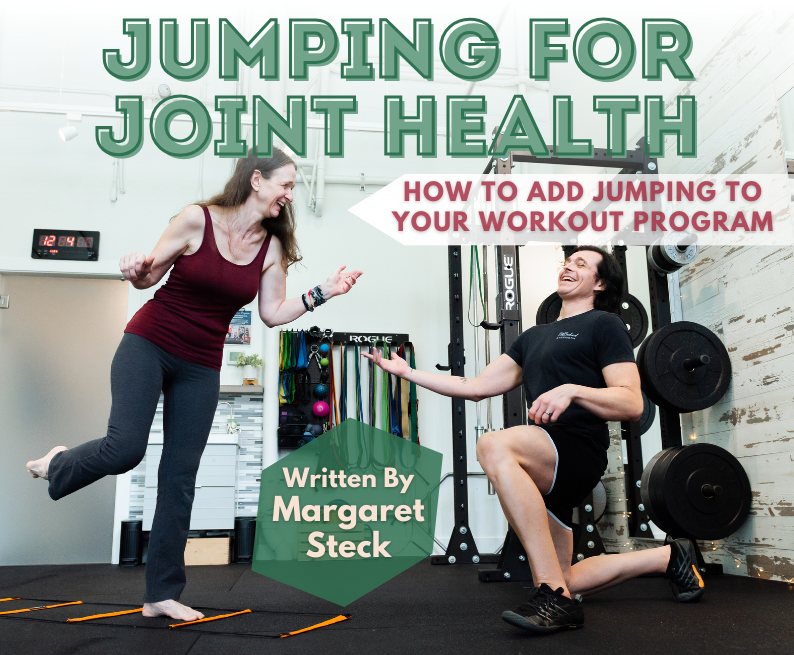
Do you remember playing hopscotch on the sidewalk as a kid? Or jumping rope during school recess? Little did we know then, that hopping, jumping, and even skipping would be beneficial to our aging joints later in life.
These kinds of movements, also known as plyometrics, provide impact between our bodies and the ground, which in turn releases lubricating synovial fluid into our joints. Think of it like WD-40 for our knees, hips, and ankles! What’s more, adding short jump intervals to your workout routine on a regular basis can improve bone mineral density which can help reduce the risk of fractures – particularly in our hips. This is remarkable because as we age, our hip bones become vulnerable to fractures.
But don’t just take it from me! Dr. Stacy Sims, a world-renowned women’s health and exercise physiologist says that “Plyometric training can improve power, speed, and agility as well as improve metabolic and bone health in women of all ages.” She also cites a 2019 systemic research review from the National Institutes of Health that concluded, “Plyometric training is a feasible and safe training option with potential for improving various performance, functional, and health-related outcomes in older persons.
Adding a jumping routine to your daily exercise regimen doesn’t need to be an intense, sweaty bout of burpees to be beneficial for your joints, either (though no shade if that’s your jam!) There are many ways to incorporate jumping to get the benefits, and no extra equipment is necessary. Remember, this is all about contact between you and the floor – landing more on the balls of your feet and your toes (as opposed to landing flat-footed).
I can honestly say that incorporating plyometrics into my training has made me a much more agile tennis player. I’m able to stay in ready-position on the balls of my feet, and take off and land much more efficiently. In daily life, I’m also able to catch myself from falling if I trip over something, which tends to happen way more than I like. To that end, I like to add a five minute jump training sesh at the end of my workout routine as a fast and fun finisher.
So, want to give it a try but not sure where to start? I got you! Consider adding one of the following jumping exercises to your workout routine. Before you do, be sure to warm up your muscles, particularly the feet and ankles. You can spend about 5-10 minutes activating your feet with exercises like short foot and banded ankle distractions, along with ankle CARs.
For beginners, start out slow, doing quick, short hops, with soft knees when you land (do not lock out your knees!) Master the movement before going for height or speed. Practice landing on the balls of your feet, just below the big toe. Let your arms swing freely as you jump. Choose one of the following and perform the exercise for 20 seconds, followed by a minute of rest. Repeat 20 on, one minute off for a total of 3 rounds:
Pogo hops (short hops in place. You can use an anchored resistance band for balance)
Forward Jumps (remember the Bunny Hop as a kid?)
Invisible jump rope (no equipment necessary but twirl your wrists as you jump)
Lateral hops (one-legged hopping side to side)
In-out hops (think of these like jumping jacks without the arms)
Skips (start in place and then try skipping forward)
Intermediate. For those ready to take it to the next level, choose one of the following and perform the exercise for 30 seconds, followed by a minute of rest. Start gradually to master the movement and then go for speed and height. Remember to land on the balls of your feet rather than your heels. Swing your arms freely with each movement to help generate explosive power. Repeat 30 seconds on, one minute off for a total of 3 rounds:
Squat jumps
Half-kneeling to single leg hops
Skaters
Single leg forward jumps
Single leg backward jumps
Broad jumps
High knees
Tuck jumps
Advanced. In this level, your focus is on explosive power with every jump. Perform each exercise for 40 seconds, followed by a minute of rest. Start gradually to master the movement and then go for speed and height. Remember to land on the balls of your feet rather than your heels. Use your arms with each movement to help generate explosive power. Repeat 40 on, one minute off for a total of 3 rounds:
Jumping lunges
Kneeling tuck jumps
90 degree hops
180 degree hops
Lateral bound to jump
If all of this feels a little daunting at first, try practicing calf raises at the sink next time you brush your teeth or do the dishes, raising yourself up and down on your toes/balls of your feet. Once you feel comfortable with the movement, add a little spring to it, keeping close to the countertop in your kitchen or bathroom for added support.
With all these suggestions, hopefully you find it easy to give jumping a try. Your joints will thank you for it and you’ll unlock that spring in your step you might not have thought you had!

Margaret Steck
Margaret Steck, ACSM CPT
I’ve always enjoyed being active, whether running, biking, or playing tennis; but over the last ten years I suffered from various injuries that ultimately led me to physical therapy.
As I healed from one injury after another, I realized that without building a solid foundation through regular strength training, I would continue to get injured and sidelined from doing what I loved.
What started out as a “thing I had to do” became a hobby, and then a passion. I loved learning about how important strength training is for everyone, especially for women in their mid-life.
I became a Certified Personal Trainer because I wanted to share my passion with women and help them become the best version of themselves so they too can enjoy what they love doing–whether it’s playing team sports or sitting on the floor with their grandchildren.