
By: Melissa Charlton
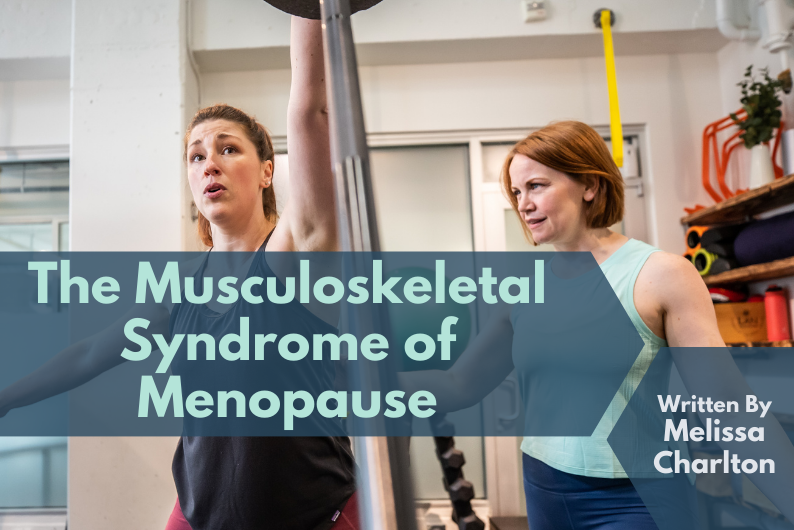
Say that 10 times fast. I’ve been stumbling on it as I try to make a reel, because this is something I want every woman to know about.
If you haven’t heard about the musculoskeletal syndrome of menopause, you’re in good company. I only learned about it LAST YEAR, because it’s a fairly new term. When I heard about it? So many light bulbs switched on.
Y’all, I’ve been doing this work for years. Do you know how many women come to us with more-often-than-average-reccurring joint issues? It can sometimes feel like Whackamole – just when you think you’ve solved one issue, another pops up. All that time, I subconsciously just thought, “it’s just something that starts to happen to women, I guess.” I had never made the connection.
We know that scientific studies almost exclusively focus on men, which means that this very common issue was only named LAST YEAR. Not discovered, but NAMED. This is an important distinction, because we all saw it happening, but never had the language to advocate for ourselves.
Doctors have known for years about the issues that plague peri and post-menopausal women. However, the conversation was always about only one of the symptoms, osteoporosis. And their primary solution was an oversimplified recommendation of calcium. This is where the conversation typically ended, and they never seemed to prescribe strength training.
Luckily, that’s changing as more and more people recognize other still-very-common-but-lesser-known symptoms of menopause, and that they all fall under this blanket umbrella: The Musculoskeletal Syndrome of Menopause.
This term was coined in a paper written and presented by Dr. Vonda Wright in 2024. (Wright #)
In this paper, Dr. Wright stresses the importance of health providers putting all the puzzle pieces together. A woman will go to her gynecologist for irregular periods and questions about her night sweats and hot flushes, and then to a sports medicine doctor for frozen shoulder. The sports med doc won’t connect the dots that mayyyybe these things are related, because why would he look at her gynecological medical history when she’s complaining of her shoulder? And women don’t bring it up, because we also don’t know that they’re related.
The good news:
Because of emerging research and emerging education, women are talking more openly about their symptoms. We’re learning to build muscle and strength training habits in our 20s and 30s, to manage our nutrition, stress and sleep in our 40s and 50s, and to maintain our strength and mobility as we take on new hobbies in our 60s and 70s. All this adds up to us actually enjoying our 80s and 90s. Instead of being bed-bound and dependent in our final decade, we build strength and habits NOW so that we can keep traveling and playing and independently taking care of ourselves.
So what causes the musculoskeletal syndrome of menopause? There’s a lot more to it, but mostly it’s a lack of estrogen (estradiol, specifically), combined with improper – or – lack of movement. Here’s why:
Estrogen works on more than just ovaries. One of its many functions is soft tissue repair and to take down inflammation. So when your shoulder is pinchy and your neck is tight, ask yourself: Am I a woman 35-55?
Now, I also mentioned movement. Because motion is lotion, and when you sit at a desk most of the day, then drive home, then cook, then watch tv and look at your phone or even read before bed? Your shoulders are going to get pretty stuck in internal rotation. And then when you bring your arm overhead? Your shoulder blade doesn’t glide. It’s sticky (oh, estrogen lubricates too). This causes the surrounding soft tissue to get pinched in between your humerus bone, your clavicle, and your shoulder blade. This then causes the pinched tissue to get inflamed.
Now what happens when estrogen tanks? There’s no anti-inflammatory hormone to calm the tissue, no muscle building hormone to build healthy muscle and repair tendons, and because the tissue is swollen, it gets repeatedly pinched each time you repeat the faulty movement pattern, thus causing an “impingement”. If ignored too long, this can turn into frozen shoulder.
And it’s not just estrogen that drops. All the other hormones that help with ovulation (follicle-stimulating hormone (FSH), dehydroepiandrosterone (DHEA), growth hormone (GH) and insulin and insulin-like growth factor-1 (IGF 1)) are also fluctuating like crazy. This is because FSH will rise to stimulate the pituitary gland, trying to trigger more estrogen production. It doesn’t work, because there are no more eggs to release, and the cascading effect is systemic. (Khadilkar #)
All these other hormones? FSA & DHEA stimulate muscle-protein synthesis and improve the activity of motor neurons. So they help us with muscle activation and synthesizing protein, the macronutrient most famous for building muscle. Don’t forget growth hormone (GH), which does exactly what you think it does. And the other two, both with insulin in their name? Hmm… do you think they play a factor in your insulin resistance? (yep, they do)
Oh, and let’s not forget about testosterone. Yep, it declines as well. It’s responsible for libido, energy and muscle mass.
All this to say: YOU’RE NOT CRAZY.
Perimenopause does a number on us, and it can last anywhere from 5-10 years! Actually, it’s kinda bullshit that people aren’t talking about it more.
So next time you go to your doctor because your back hurts, your knee is clicking, your hip sticks when you stand up, you have plantar fasciitis, your fucking big toe hurts (mine hurts so much!), your wrist hurts, or your shoulder is suddenly in incredible pain… cross reference. Do you have other symptoms?
A good doctor will ask questions relating to perimenopause (if you’re between 35-55). They’ll help you connect the dots. And although they’ll offer you medicinal options to help you (that’s their job, so I get it), the best doctors will also stress the importance of learning proper mobility, and they’ll repeat ad nauseum that you need to pick up some dumbbells.
I’ll also be annoyingly persistent in this messaging.
We need to learn how to move in ways that avoid inflammation, learn to listen to those pain signals instead of ignoring them while we move, and get ourselves under or over a barbell. Pilates is fanTASTIC for posture and muscle endurance, yoga is great for flexibility. But you MUST absolutely, LIFT WEIGHTS. …If you want to try to avoid all the problems that come with perimenopause, I mean.
And if you need some solid medical advice? Ha! I’m not your girl. But Meghan is! Have you met our partner, Dr. Meghan Tierney? She’s board certified, specializing in helping women navigate midlife hormones and metabolic changes during peri and post menopause. Check out her blog from December 2025, The Stress Hormone and What It Means for Your Workout and Your Life.
Have more questions about the menopause transition, and how it affects your movement and goals? Drop them in the comments below, we’d love to help.
Works Cited
Khadilkar, Suvarna Satish. “Musculoskeletal Disorders and Menopause.” Journal of obstetrics and gynaecology of India, vol. 69, no. 2, 2019, pp. 99-103. 10.1007/s13224-019-01213-7, https://pmc.ncbi.nlm.nih.gov/articles/PMC6430266/#:~:text=Effects%20of%20Hormones%20on%20Musculoskeletal,hormones%20play%20a%20major%20role.
Wright, Vonda J. “The Musculoskeletal Syndrome of Menopause.” Taylor & Francis Online, vol. Climacteric 27, no. 5, 2024, pp. 466-72. Taylor & Francis Online, 10.1080/13697137.2024.2380363.

Melissa Charlton
Founder, NASM CPT, GGS Menopause Specialist
I am inspired by my mother, who gave it her all to give us a better life. Leaving a bad marriage but still needing to raise four children, my mom did everything she could to make ends meet. This meant learning new skills and working 16-hour days, constantly wearing herself down and pouring from an empty cup. She’s my hero, but she’s also my cautionary tale.
Now I'm a mother and a business owner, and I owe it to my son and my community to prioritize myself while I build a business that supports women just like her. I consider it my honor to teach you how to take better care of YOU. So you can be the leader your people need. Proper self-care makes it possible for you to give the best of you, rather than just the rest of you.